

Why I Would Not Live in a Historical Center Again
Updated: Aug 29
Charm versus Convenience
It might be interesting to share how we pulled off living in Italy for part of the year. I will post some steps and what we are learning along the way.
We love every minute of it, and what was once a dream is now our life!
We live in Tuscany in the fall, return again in the spring, and spend the rest of the time in California. In a previous blog, I explained why we live in Italy only part of the year.
As we explore areas in Italy, we discover some gems worth sharing. Some are well-known tourist magnets, and others are lesser-known but always worth the detour.

Step 1: This week let's explore our experience of living in a historical center in Italy — and why we wouldn't do it again.
Step 2: We were swept away by the charm of a 15th-century house in the historical center of a town we discovered in Tuscany. Stone walls, wood-beam ceilings, and terra cotta floors gave the home a sense of history that was a world away from our life in California.
In other blogs, I recounted how we upgraded the home while keeping its original character — a new kitchen, a second bathroom, an upgraded main bathroom, double-pane windows, and a redone roof. But even with all of that investment, we eventually decided that living in the historical center was not for us.
Keep in mind that this blog reflects our personal experience and does not claim to speak for everyone who lives in a historical center.
So what were the issues that led us to that decision?
Step 3: Parking
When we bought the house, we knew we would have to rely on street parking some blocks away — a small price to pay for living in a town that was once a pilgrimage stop under the protection of the Knights Templar, just down the hill from a castle once inhabited by the Medicis.
But over time, lugging cases of water, groceries, bags of pellets, and other supplies wore us down. When a festival or market came to town, parking near our place would disappear entirely, and we would end up hiking in from wherever we could find a spot.
Parking and hauling goods home became more of a grind as time went on — but it was not the only factor that led us to leave.
Step 4: Darkness
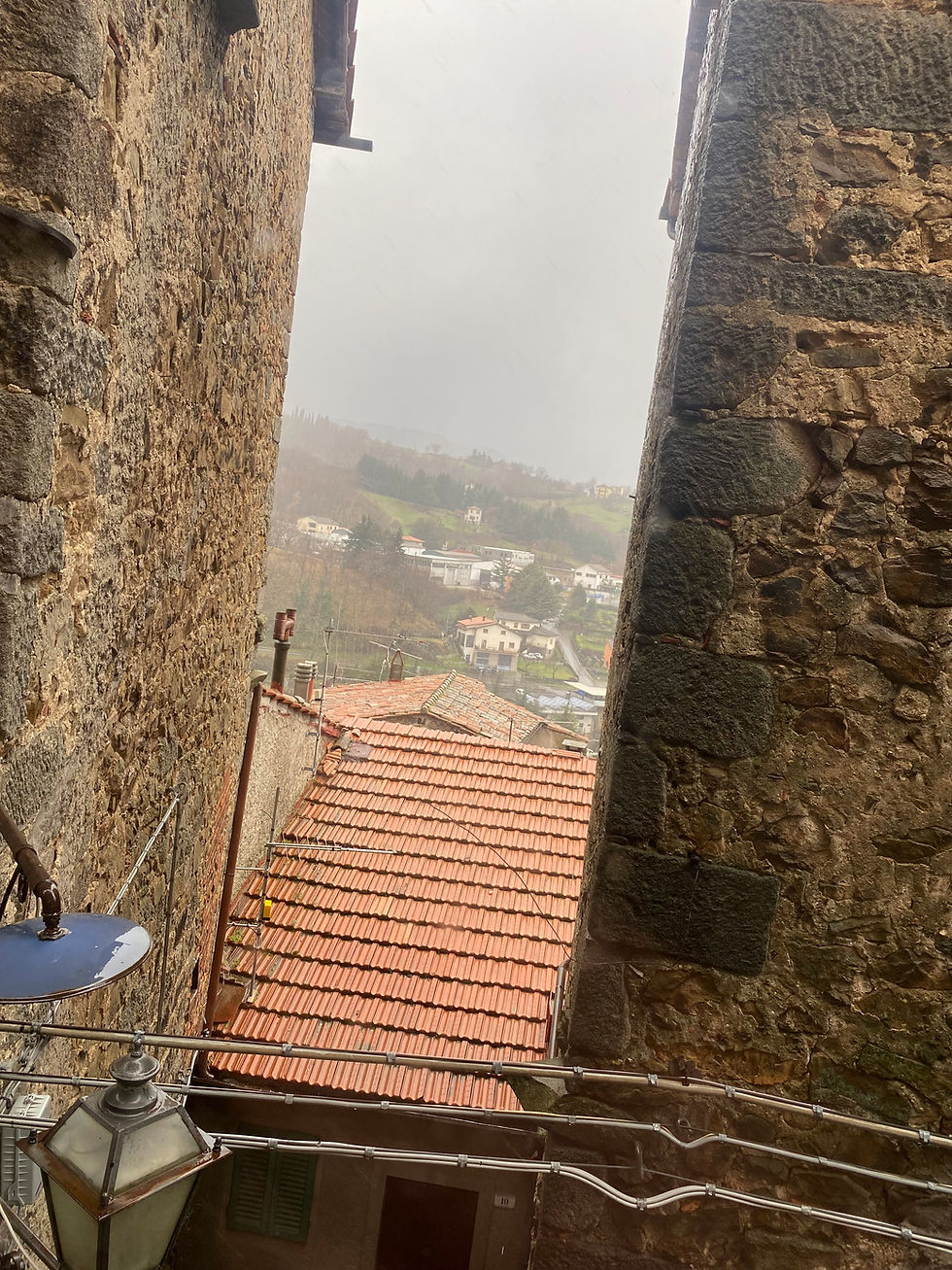
Most homes in historical centers were built with small windows, and views are often blocked by the building directly across the narrow lane. Ours was no exception.
At first, that was part of the charm — think of the history, the people who had lived there, the stories those stones had witnessed. But the reality is that many such homes are simply dark. Buildings packed tightly together mean that direct sunlight rarely reaches inside, and ours was no different. Coming from California, I missed the light more than I had expected. On rainy days especially, the house felt closed in.
You might find a home on the edge of a historical center with more open views, but many homes — built surrounded by other historical buildings — live in the shadows.
Step 5: Drafts and Heat
Our home came with two pellet heaters — one in the main bedroom and one in the kitchen. The kitchen unit took up too much floor space, so we had it removed and replaced with heat-generating electric logs in the fireplace.
What we discovered was that no matter how much heat we generated, drafts remained.
Many historical homes were never designed to be wind-tight, and we did what we could to address that. Whether the drafts came through the front door area or from some other unknown source, we could never eliminate them entirely. Some neighbors had installed glass wind proof doors over their front entrances, which probably helped — we considered doing the same. We also went to the expense of installing double-pane windows throughout, but the drafts remained. The best we could do was seal off rooms and heat them sufficiently while other areas stayed cold.

Step 6: Water Issues
Our historic home had a tile roof, and one exterior side of the building was made of exposed stone and mortar — beautiful to look at, but with downsides.
Not long after purchasing the home, we had leaks from the roof that sent us into a panic. Our contractor climbed up and found that the tile roof had no sealer or tar paper beneath it — just tiles laid directly on the wood structure. Our realtor told us this was common in historical centers in our area of the Monte Amiata, and that it had generally been sufficient. But with the increasingly heavy wind-driven rains of recent years, such roofs were no longer reliably water-tight. We had the tiles removed, sealed the roof underneath and then replaced them; the roof is now water-tight, but it was a stressful and costly lesson.
The stone exterior walls presented a similar issue. The only thing keeping water from seeping through during a driving rainstorm is the mortar between the rocks, which in some cases may be centuries old. We had water dampen interior walls during strong storms, and had to take the necessary steps to resolve it.
Step 7: Pellet Heating and Air Quality
Nearly all of our neighbors in the historical center relied on pellet heating, as did we. It generates strong heat and is cheaper than most electric or gas options in Italy. But it comes with downsides.
The first is practical: keeping a supply of pellet bags on hand means lugging them from the car and finding somewhere to stack them inside.
The second issue — for me, the more significant one — is air quality. On cold days, stepping outside sometimes meant walking straight into a cloud of pellet smoke. I have a history of asthma, and the acrid smoke from all those heaters burning at once would irritate my lungs. I learned to carry my inhaler whenever I went out. What seemed like a minor inconvenience at first became a genuine concern: on colder days, clean air in our historical center was simply unavailable.

Step 8: Vacant Properties
Our historical center, like many others, had a significant number of vacant properties — some listed for sale, others simply abandoned. What we came to understand is that many locals do not want to live in the historical center, for exactly the kinds of reasons I have described here. So properties sit unsold, waiting for a foreign buyer drawn in by the charm.
Being surrounded by vacant homes began to concern us. We decided it made more sense to invest somewhere that locals also want to live.
Step 9: Delivery Issues
Because vehicles cannot enter most of the historical center, getting larger items delivered — appliances, furniture, construction materials — became a real logistical challenge. Our contractor had to hire workers simply for moving materials from the truck to our front door, and for hauling away debris. It is an added cost and complication that comes with the territory.

Step 10: Our Solution
What it came down to, in the end, was a choice between charm and convenience. We chose convenience.
We moved to Santa Fiora, where we live just across the bridge from the historical center in a six-unit, more modern condominium building with a new roof and a restored facade. We are close enough to enjoy all the charm of the centro storico on a daily walk, without actually living inside it. Large windows, lots of light and new electric and plumbing turned out to be the best fit for us.
We are grateful for our time in the historical center — we learned a great deal from it. But we are equally grateful to have moved on to something that simply works better for how we live.
More next time.

If you have enjoyed reading about our life in Italy, my memoir goes deeper into where it began.
Stories from Puglia: Two Californians in Southern Italy — the memoir of finding our way through the towns, food, and people of the deep south.
"This book elevated my trip. Well written and fun." — Amazon reviewer. https://a.co/d/0340l3Ak


Everything you mention makes sense now that I know more about what a historical center is here in Italy. I can see being seduced by the charm at first. Understandable. In moving to Florence I knew I did not want to be in the city center, primarily because of the legendary crowds. On one hand I enjoy living in a city that is so popular among people from around the world. I just don't necesarily want to see them every day.
I live in the hills to the north of the city, about 6 km away which means it is easy to drive to the center when I want. I think of it as having the best of both worlds. I…
We live in the historic center of Ascoli Piceno, a town of about 50,000 in the Marche. I agree with most of what you say. However, there are some things about our apartment that differ from yours.
Our 3-story building dates from the 17th C. It was once the residence of a single family. In the early 20th C. the building was subdivided into several apartments, several of which were decorated with magnificent ceiling frescoes. In the 1980s. the building was renovated again, and modern plumbing, electrical systems and an elevator were installed. We have central heating - forced hot air, with radiators. So we don't need pellets. We even have a dedicated parking space.
Because we are on a…