
Should You Live in Pienza?
Updated: May 6
The ideal Renaissance town
About This Series: Living part-time in Tuscany has turned us into passionate scouts for towns that could welcome fellow international residents. After years of splitting our time between southern Tuscany and California, we've learned to evaluate places through the lens of someone considering making Italy home. During the following months each blog will be dedicated to a unique town, examining everything from practical conveniences and community life to tourist impact and daily challenges. Our goal is to provide authentic, unvarnished insights for fellow international residents considering making Italy home, whether full-time or part-time.
This week, we're exploring Pienza. It's a UNESCO World Heritage site and the first example of planned Renaissance urban design. The town is beautiful, the views are famous, and the pecorino cheese is legendary. But living here means sharing your home with thousands of tourists. Whether that's a dealbreaker depends on you.

Our Experience
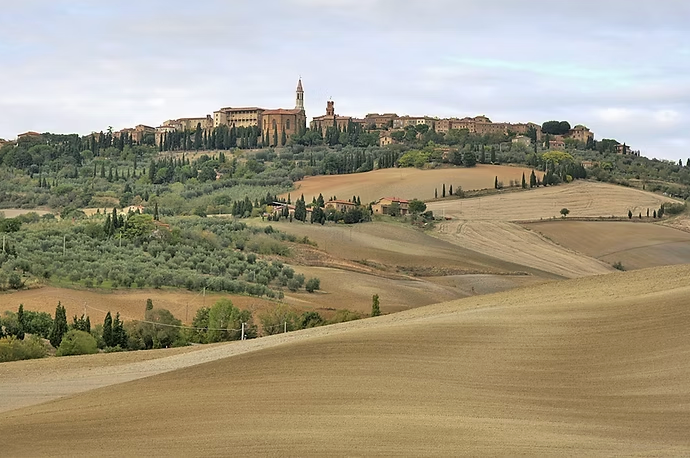
I can still remember the first time we visited Pienza. The stone buildings in the historical center framed views of the Val d'Orcia's rolling hills that seemed almost unreal. It was summer, and the town was packed with tourists, many of them Americans. But that didn't bother me—I was too fascinated by the place itself.
Pienza is the Renaissance ideal city, consciously designed by Pope Pius II to embody principles of harmony and balance. It's the first example of planned urban design, and walking through it, you feel that intention in every carefully positioned building and piazza.
The cathedral stopped me in my tracks. With its soaring Gothic interior and huge clear glass windows, it felt more Northern European than Italian, flooding the space with light. Yet Renaissance paintings on the walls reminded you exactly where you were. I found it both beautiful and meditative, though the sloping floor and visible cracks in the walls made me acutely aware of time and gravity at work. The floor slopes because the cathedral's rear section extends over unstable clay soil that has been gradually shifting since construction—a reminder that even Renaissance perfection must reckon with geology.
We've returned many times since, eating at various cafes—some excellent, others just okay, like any tourist destination. For me, Pienza is about those views over the Val d'Orcia. For others, it's the famous pecorino cheese, and I understand that too.
We keep coming back. Even the newer parts of town have their charm. My partner always says he'd love to live here, though it's well out of our price range. Maybe not out of yours though.

Location & Accessibility
Pienza sits at about 1,755 feet in the Val d'Orcia, in the heart of the famous Tuscan landscape.
Transportation Options:
Airports: Florence is about 2 hours by car, Rome Fiumicino about 2.5 hours
Trains: Chiusi-Chianciano Terme station is 45 minutes away, with high-speed connections to Rome (1h 15m) and Florence (1h 30m)
Buses: LFI runs to Montepulciano and Siena, but schedules are limited
Nearby: Montepulciano (15 minutes), Montalcino (20 minutes), Siena (1 hour)
You'll need a car. The location is central, which makes it a good base for exploring the region.

Historical Significance
Pienza started as a humble village called Corsignano. In 1459, Pope Pius II decided to transform his birthplace into an "ideal Renaissance city." Working with architect Bernardo Rossellino, he created what UNESCO now calls "the first application of the Renaissance concept of urban design."
The pope's idea was that harmonious architecture could create a better society. He died before finishing the project, but the three-year building campaign produced something remarkable—a town designed according to humanist principles rather than just growing organically over centuries.
The town was renamed Pienza ("Pius's city") in his honor.
Visual Character
The Renaissance center is contained within medieval walls. Honey-colored travertine buildings surround Piazza Pio II, which is often called one of Italy's most beautiful squares.
The cathedral forms the backdrop. The Palazzo Piccolomini's hanging gardens offer views across the Val d'Orcia to Monte Amiata. Every street, every building, every vista was designed deliberately. Five centuries later, you can still feel it.
The main street, Corso il Rossellino, has views of the countryside framed between buildings. It's beautiful. It's also full of tourists.
Distinctive Features
Architecture:
Palazzo Piccolomini: The pope's residence, with a triple-loggia overlooking gardens and panoramic views
Cathedral: Gothic interior with enormous windows flooding the space with light. The building is slowly settling—the cracks and sloping floor are part of its character now.
Underground: Etruscan and Roman foundations visible in the Palazzo Vescovile's basement
Recognition:
UNESCO World Heritage site (1996)
"I Borghi più belli d'Italia"
Practical Conveniences
Basic Information:
Population: About 2,085
Internet: Reliable broadband in the historic center
Housing Costs:
Rentals: €600-€900/month average; 2-bedroom apartments from around €700. Higher than surrounding areas because of tourism.
Buying: €2,800-€3,500 per square meter—well above regional averages due to UNESCO status and tourist appeal. Small apartments start around €150,000. Houses with views run €300,000+.
Note: Prices from Immobiliare.it and Idealista (September 2025).
Services:
Basic needs met locally: alimentari, pharmacy, tourist shops
Major shopping requires trips to Montepulciano or Siena
Parking limited in the historic center; residents can get permits
UNESCO protections mean any building modifications require extensive permissions.

Community & Social Life
Pienza has a mix of longtime residents and newer arrivals drawn by the town's beauty. There's an established expat community, though smaller than in larger towns.
English is more common here than in most Tuscan villages because of international tourism. But Italian is still essential for real integration.
The constant tourist presence creates a unique dynamic. You're never truly anonymous, but you're also not the only outsider. Living here means sharing your daily environment with thousands of visitors during peak season.
Tourism Impact
This is the reality of Pienza: during peak season (April-October), thousands of visitors come through daily. Streets get crowded. Restaurants book up. Parking disappears.
Tourism sustains local businesses and funds preservation. But residents adapt—shopping during off-peak hours, finding quieter routes, accepting that the main piazza isn't really theirs in summer.
Winter is different. The tourists leave. Mist rolls across the Val d'Orcia. You can hear your footsteps on the Renaissance stones. Some businesses close or reduce hours, but you get the town back.
Cultural Attractions & Leisure
Sites:
Palazzo Piccolomini state rooms and gardens
Diocesan Museum with illuminated manuscripts
The cathedral
Experiences:
Pecorino cheese tastings—Pienza is synonymous with pecorino di Pienza DOP. Shops everywhere offer varieties aged in different conditions.
Architecture tours
Classical music concerts
Festivals:
Fiera del Cacio (first Sunday in September): Cheese festival
Medieval festivals throughout the year
Day Trips:
Bagno Vignoni thermal baths (15 minutes)
Montepulciano (15 minutes)
Montalcino (20 minutes)
You're in the heart of the Val d'Orcia—everything is close
Photography:
Some of Italy's most photographed landscapes are literally at your doorstep. If you're a photographer, this is paradise.
Daily Life Through the Seasons
Summer: Warm, low 80s°F. Also the heaviest tourist crowds. Tour buses arrive continuously. Restaurants are fully booked. The town can feel overwhelmed on peak weekends.
Autumn: Perfect balance. Moderate crowds, ideal weather, the Val d'Orcia at its most photogenic with autumn colors.
Winter: The town returns to residents. Mist, quiet streets, some businesses closed. You can actually experience the Renaissance stones without crowds.
Spring: Wildflowers, moderate tourists, beautiful weather. Another sweet spot.
Living here successfully means embracing this rhythm—enjoying the energy tourists bring while knowing how to find peace when you need it.
Practical Challenges
What to know:
Tourists: You'll navigate daily crowds during peak season. This is non-negotiable.
Cost: Housing and some services are expensive because of the tourist economy.
Parking: Restricted in the historic center. You'll need a resident permit.
UNESCO regulations: Strict requirements for any building modifications. Renovations are complicated.
Jobs: Limited year-round employment. The economy depends heavily on tourism.
Healthcare: Basic services locally; hospital care requires travel to Montepulciano or Siena.
The Verdict: Pienza at a Glance
Ideal for:
History and architecture enthusiasts who want to live inside a Renaissance masterpiece
Photographers and artists
Those seeking a central Tuscany location for regional exploration
People comfortable with tourist environments
Remote workers who thrive in inspiring surroundings
Consider carefully if:
You prefer quiet, undiscovered places
You need affordable housing
You want to avoid tourist crowds
You require local employment opportunities
You value privacy and anonymity
Our assessment: Pienza offers something rare—the chance to live in one of the world's most deliberately designed towns, surrounded by the landscape that defines the Tuscan ideal. The tourist presence is real, and during summer it's intense. But it also ensures good restaurants, cultural events, and a community that's accustomed to outsiders.
It's out of our price range. My partner would move here tomorrow if we could afford it. The views, the architecture, the cheese, the light—it's genuinely special.
But you have to be honest with yourself about the tourists. If sharing your hometown with the world sounds exhausting, look elsewhere. If it sounds exciting, or at least manageable, Pienza might be exactly what you're looking for.
More next time: We'll continue exploring other captivating towns in our area that caught our attention during our ongoing search for perfect destinations for international residents.
My new novel is on sale now for $2.99! "Onward: A Life on a Sailboat" is a tale that will draw the reader to the Amalfi coast, the deserts of Algeria, the south of France, and beyond. https://a.co/d/3hhJkxE
Amazon Italy- my book "Lei mi ha sedotto. Una storia d'amore con Roma": https://amzn.eu/d/13nuZCL.
Please check out my blog: https://www.marktedesco.com/blog


Comments