
Why Albania Can Make the Schengen Shuffle Work
Updated: Jul 14
Living in Europe full time, with Italy as a base and Albania as the reset
It might be interesting to share how we pulled off living in Italy for part of the year. I will post some steps and what we are learning along the way.
We love every minute of it, and what was once a dream is our life!
We live in Tuscany in the Fall, then back again in the Spring, and in California for the rest of the time (in a previous blog, I explained why we live in Italy only part of the year).
As we explore areas in Italy, we discover some gems worth sharing. Some are well-known tourist magnets, and others are lesser-known but always amazing.
This week lets explore how to make the Schengen Shuffle easier, with Albania in the mix.
The bottom line: The flexibility of spending part of the year in Albania can make the Schengen Shuffle workable for those who want to live in Europe full time with Italy as their base, without changing their residency. (What is the Schengen Shuffle? See: https://www.marktedesco.com/post/the-schengen-shuffle).

Step 1: How to live in Europe full time without changing your residency.
Some readers have written asking how to spend more than three months at a time in Italy. They want to live in Europe full time, but without changing their residency from their home country.
For them, the Schengen Shuffle is the practical answer. And Albania is an option that can make it work.
Several countries outside the Schengen zone can serve the Shuffle — the UK, Ireland, Turkey, Georgia, and the Balkans (Serbia, Montenegro, Bosnia, Kosovo, North Macedonia), among others. We'll be exploring several of these in future blog posts. But Albania has something the others do not: Americans can stay there for a full year, visa-free.
That is what makes Italy-as-a-base workable for those willing to do the Shuffle. Albania becomes the place to legally wait out the 90 days you cannot be in Italy, before returning to Italy for another 90.
We are not doing this ourselves — our split of Tuscany in the fall and spring, with California in between, fits comfortably within the 90-day Schengen window. But the question is a real one, and we have a personal connection to it: here in Tuscany, we have several Albanian friends who came to Italy years ago for work. They speak fondly of home — the beaches, the food, the welcome they get on visits back — and they tell us we should go.
Let me share what we have learned.
Step 2: The one-year rule.
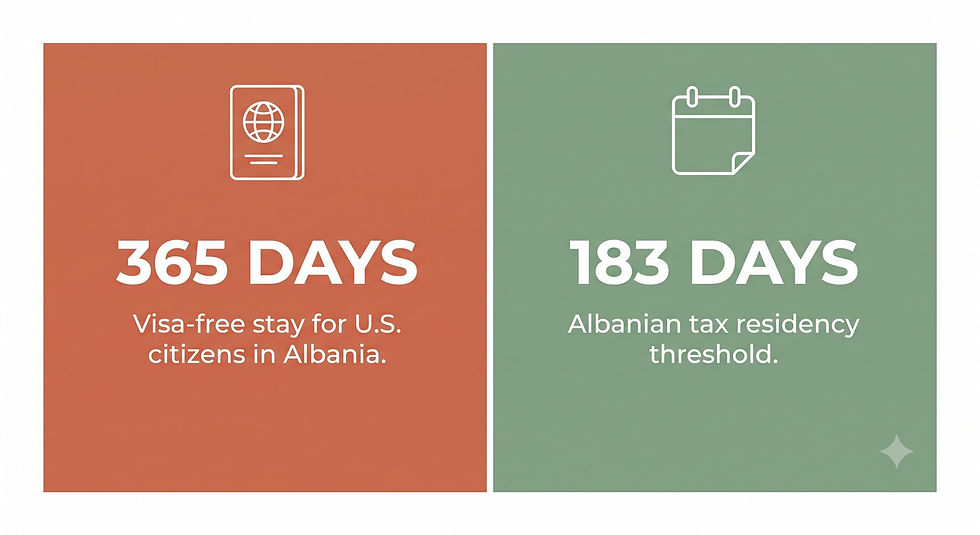
This post rests on two facts, and they belong together.
The first: U.S. citizens can stay in Albania for one full year without a visa, a residence permit, or any application. Just a passport. No other country in Europe offers Americans this kind of access.
The second: stay more than 183 days in a calendar year and you become an Albanian tax resident. We will come back to this in Step 11, but it shapes everything that follows.
The first fact is what makes Albania remarkable. The second is what keeps it practical only within limits.
The one-year stay comes from a bilateral arrangement between the United States and Albania, formalized in 2022. As of 2026, it remains in force, and the U.S. Embassy in Albania confirms it on its official site: https://al.usembassy.gov/entering-and-residing/
A few details worth knowing:
Your passport must be valid for at least three months beyond your stay. Airlines often require six months, so check with your carrier.
On arrival, Albanian border officers traditionally stamped your passport. Lately, many entries are logged electronically without a stamp. Save your boarding pass as proof of your entry date, just in case.
To "reset" the one-year clock and stay another year, you must leave Albania for 90 consecutive days. Shorter trips outside the country do not reset the timer.
This rule is specific to U.S. citizens. Citizens of the EU, UK, Canada, and Australia generally get 90 days within a 180-day period, like the Schengen rule.
The one year is a visa rule, not a tax rule. Albania uses a separate calendar-year clock for tax residency. Spending more than 183 days in any one calendar year — even if you are well within your visa-free year — makes you an Albanian tax resident. We address this in Step 11.

Step 3: How the math works with the Schengen Shuffle.
Here is the key insight. For someone who wants to make Italy their base, the Schengen rules limit you to 90 days at a stretch. After that, you must leave the Schengen Area for 90 days before you can return. Albania is the easiest, cheapest place in Europe to spend those 90 days out.
In practice, a typical year for someone with Italy as their base could look like this:
90 days in Italy → 90 days in Albania → 90 days in Italy → 90 days in Albania
That gives you the legal maximum of 180 days in Italy across the year — your home, where you really want to be — with Albania filling the off-periods between your Italian stretches.
Other patterns work too. You could use Albania for one off-period and somewhere else (the UK, Turkey, Ireland) for the other. You could break a 90-day Albania stretch into shorter trips around the region.
Either way, Italy can be your home for half the year, legally and reliably. Where to spend the off-periods is the next question.
Step 4: Albania compared to other non-Schengen options.
Turkey, Montenegro, Serbia, and the rest of the Balkans accept Americans visa-free, but only for 90 days at a time, followed by 90+ days out. For a rigid Italy/off/Italy/off pattern, they work as well as Albania.
Albania's real advantage is flexibility.
Within your one-year visa-free window, you can come and go freely — in any stay length — as long as your total Albanian days stay under 183 in the calendar year. So you could spend two weeks in Albania, slip down to Greece for ten days, return to Albania for a month, take a trip back to the US, and come back again. The 90/180 countries do not allow this kind of in-and-out movement; once you leave, you start a long clock before you can return..
Three other practical advantages:
Proximity. Bari to Durrës is the closest non-Schengen exit from Italy.
Italian-friendly culture. Italian is widely understood, especially in cities and along the coast.
Cost. Albania is among the cheapest options in Europe.
For a strict 90-on/90-off rhythm, Turkey or Montenegro work just as well. For anything more flexible, Albania is the practical choice.

Step 5: Getting there from Italy.
The easiest entry point to Albania from Italy is the overnight ferry from Bari to Durrës. The crossing takes 8 to 10 hours, with most departures leaving Bari around 10 p.m. — you sleep on board and arrive in time for breakfast in Durrës.
Tickets run €45 to €75 one-way, and you can bring a car for around €80. The route runs year-round with multiple daily crossings in summer and fewer in the off-season. Adria Ferries and Grandi Navi Veloci are the main operators; ferryhopper.com lists current schedules.
Flying is faster. Tirana International Airport is well-connected to Rome, Milan, and Bologna, with flight times around 1 hour 15 minutes and tickets often under €100.
For the Shuffle pattern, the ferry is more flexible — you can bring more belongings, including a car — but flying is the simplest option.

Step 6: Where in Albania to consider.
Albania is a small country, smaller than the state of Maryland, but it has remarkable variety. Four areas come up most often in expat conversations:
Tirana (the capital): Albania's main city and the country's economic and cultural center. The Blloku neighborhood — once sealed off for communist elites, now the heart of café and restaurant culture — is the expat favorite. Tirana has the best internet, the most international restaurants, the busiest social scene, and the country's main airport. The downside: chaotic traffic and significant urban sprawl.
Saranda: A coastal town on the Albanian Riviera, just across from the Greek island of Corfu (30 to 45 minutes by fast ferry). Lively in summer, much quieter in winter. Popular with Albanians and a growing number of foreigners. Lower cost of living than Tirana, but smaller in every sense.
Durrës: Albania's main port and second-largest city, with a long beachfront and 3,000 years of history. Convenient for ferry access to Italy, more developed than the Riviera, less polished than Tirana. A practical choice for someone who wants to keep close ties to Italy.
Vlorë and the southern coast: A growing region of beach towns, less developed than Saranda but easier to live in year-round. Vlorë specifically has been seeing more investment and a small but steady international presence.
Our Albanian friends in Tuscany have told us that the coastal villages remind them of how Italy looked decades ago — small, unhurried, and not yet remade for tourism.
Step 7: Cost of living.
This is where Albania really separates itself from Western Europe. A single expat can live comfortably in Tirana for $900 to $1,500 per month, all in; the Albanian Riviera runs slightly higher. The same lifestyle in much of Italy could easily cost twice as much, depending on the region.
A meal at a local restaurant runs $3 to $6, and groceries for one person cost about $100 a month. Public transit and ride-sharing in Tirana are very cheap. Imported goods carry a 40 to 60 percent premium, which is worth knowing if you have specific brands you cannot live without.
On the services side, high-speed fiber internet is under $30, utilities for an 85 m² apartment land around $100, and a visit to a private clinic is $20 to $40.
For a fuller breakdown, Numbeo's Albania page is the easiest place to compare specific categories.
Currency note: Albania uses the lek (ALL), not the euro. As of mid-2026, 1 USD is roughly 82 ALL. Rent is often quoted in euros even though daily expenses are in lek.

Step 8: Renting for three months — and a note on buying.
For your 90 days outside the Schengen Area, three months is the natural unit: you arrive in Albania, settle in, then return to Italy for your next 90-day stretch. Here is what to expect.
Renting for three months
Albanian landlords generally prefer 12-month leases, but three-month rentals are common in tourist-oriented cities and increasingly available in Tirana through local agencies and Airbnb. A furnished apartment in central Tirana (Blloku, Pazari, Rruga e Kavajës) runs about $500 to $600 per month, or roughly $1,500 to $1,800 for three months. Outer neighborhoods run noticeably less. The Riviera and Vlorë are cheapest in the off-season — €200 to €300 per month — but prices spike sharply in summer, and long-term rentals become hard to find at all. Soviet-era buildings are cheaper but expect older heating, plumbing, and sound insulation.
Furnished apartments are standard for foreigners. Deposits are typically one to two months' rent, usually quoted in euros but paid in lek.
For finding places, Tirana Rentals is a useful English-language site. Local agencies like Century 21 Albania, Habita, and RE/MAX Albania handle longer leases. Airbnb's monthly rates (often 30 to 50 percent off the nightly rate) work well for your first 90-day stretch while you scout the market.
A note on buying
If you stay long enough to want a real base, buying in Albania is unusually accessible. Foreigners have the same property rights as Albanian citizens under Law 7850 of the Albanian Civil Code, with no special permits required. You do not need a residence permit to buy — many foreign buyers complete purchases from abroad using a power of attorney with a local lawyer. The one significant restriction is that foreigners cannot directly own agricultural land, though registering an Albanian company gets around that.
Sample 2026 prices: a one-bedroom apartment in central Tirana runs €90,000 to €150,000; outer Tirana runs less; sea-view apartments on the Riviera go for €2,200 to €3,000 per square meter. Closing costs run 3 to 5 percent. Annual property tax is striking: 0.05 percent of value — a €200,000 villa carries about €100 a year.
An important caveat: Albanian property prices rose 18 to 26 percent in 2024, and coastal areas in some cases more than 30 percent. There is real risk of buying at the top of a hot market, and Albania has no centralized property listing service, so working with a verified local advisor — and doing thorough due diligence on title, permits, and encumbrances — is essential.
For most Schengen Shufflers, renting first — for a year or two — is the prudent path.
Step 9: Practical setup.
A few practical notes. Banking is slow for non-residents, so most long-stay foreigners simply use Wise or Revolut for everyday spending and ATM withdrawals. A local SIM from Vodafone Albania or One Albania runs $10 to $15 with generous data; home internet is unusually fast and cheap.
Public healthcare exists but most expats use private clinics, which are modern and affordable, with English-speaking doctors common in Tirana. For anything serious, many foreigners travel back to Italy, the UK, or the United States. Tirana traffic is widely described as among the worst in the Balkans, though roads outside the capital are improving.
Albanian is unrelated to any major European language family, but English is widely spoken among younger Albanians, and Italian is common along the coast and among older generations who grew up watching Italian television during the communist era.
Step 10: The expat community.
Albania's foreign community is small but growing. The largest groups are returning Albanians from the diaspora, retirees from the UK and northern Europe, digital nomads from various countries, and a smaller but increasing number of Americans drawn by the one-year rule.
Tirana hosts several coworking spaces and an active digital nomad scene centered in Blloku. Saranda has a smaller but established summer community. Facebook groups like "Expats in Albania" and "Americans in Tirana" are active and useful for housing leads, advice, and meetups.
By all accounts, the community is friendly and unpretentious. There is none of the established expat hierarchy you find in long-settled places like the south of France or Tuscany itself. People are still figuring it out together.

Step 11: Honest considerations.
A post like this would not be complete without naming what is harder about Albania:
It is a developing economy. Our Albanian friends in Tuscany did not come to Italy for fun; they came because work at home was scarce. The infrastructure has improved enormously since the 1990s, but Albania is still catching up to Western Europe in many practical areas. Power outages happen. Reliable plumbing is not a given in older buildings. Bureaucracy can be opaque.
Healthcare quality varies. For routine care, Tirana's private clinics are good and affordable. For anything serious, many foreigners leave the country.
Driving and traffic. As noted, Tirana traffic is genuinely difficult. If you plan to drive regularly, this should factor in.
Tax residency. Spending more than 183 days in Albania in a calendar year makes you an Albanian tax resident. The typical Shuffle pattern (90 days in Italy, 90 in Albania, 90 in Italy, 90 in Albania) puts you at 180 days per calendar year, just under the line. The United States and Albania have no tax treaty, so Americans who cross the threshold have no protection against double taxation. Track your days carefully, and consult a tax professional before planning a year that approaches 183 days. Days of Stay is a free tool that handles both the 183-day rule and the Schengen 90/180 rule.
Cultural distance. Albanian language, customs, and history are distinct from Italian or Western European norms. Not difficult, but different. Friends who have visited tell us that Albanian hospitality is exceptional, but you will be a clear outsider in a way you might not feel as an American in, say, Florence.
Political and economic context. Albania is a NATO member and an EU candidate country, and the trajectory is broadly positive. But it is not the EU, and the institutional environment is less mature than in Italy.
Step 12: A sample year with Italy as your base.
For readers who want to visualize what this could look like, here is one possible structure:
January–March: 90 days in Italy
April–June: 90 days in Albania
July–September: Second 90-day stretch in Italy (or another Schengen country)
October–December: 90 days in Albania, or split with another non-Schengen destination
The result: roughly six months in Italy, the legal maximum under the Schengen rule, with Albania serving as the most affordable and accessible base for the time outside it.

Insights: The Schengen Shuffle offers a real answer for those who want to live in Europe full time without changing their residency. Italy can be the base, and Albania's one-year visa-free rule for Americans makes it the most accessible place to spend the 90 days outside the Schengen Area. The math works — 180 days in Albania per calendar year, just under the tax residency threshold — but only with careful planning. For those willing to do the Shuffle, Italy plus Albania makes a fuller European life possible.
More next time.

If you enjoy reading about Italian life, you may enjoy my book on southern Italy — where two Californians meet a region shaped as much by its history as by the people living in it now.
Stories from Puglia: Two Californians in Southern Italy — a book of southern Italian life, culture, and history, told through my own experience of the region and the stories behind its towns, its people, and its past.
"This book elevated my trip. Well written and fun." — Amazon reviewer


Comments