
How the Magi Found Me
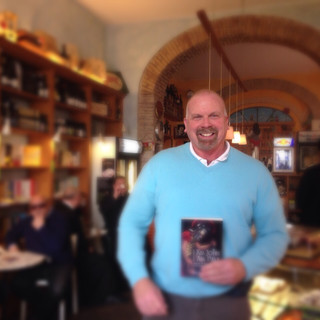
Swept up in an ancient journey
This week I am setting aside my usual step-by-step format for a more personal piece.
It is about a book I have been working on for a long time, and about a handful of moments — one of them in Ravenna — that shaped it along the way.

Do you remember how excited you were as a child at Christmas? I remember one year in particular — I was seven or eight — when I dreamed it was Christmas Eve. I woke certain the big morning had come — the mystery of what had happened during the night: presents under the tree, breakfast already laid out, the turkey already in the oven. And always, carols — at church, or blasting from our record player.
I walked into the living room in my one-piece pajamas, and my face fell. No tree. No presents. No smell of turkey from the kitchen. It had only been a dream. The magic passed, and I had another six months to wait.
The memories of those years — the feelings, the images, the joy of that season — have stayed with me into adulthood. But somehow, without the magic. Was it gone for good?
Later in life, I turned to Dickens during the holiday season — A Christmas Carol every December, no matter what else was on my nightstand. Reading it stirred the comfort of the season, but that childhood wonder stayed elusive. Was there another story that could draw me back into the world of mystery I'd known as a child? I couldn't find one. Perhaps I would have to write it myself.
That thought didn't leave. What began as a search for that childhood magic became something larger as I wrote — as the characters drew me into their search for meaning, for destiny, and for a sense of purpose that we all long for in the end. But that's getting ahead of myself.
Ravenna
I had always wanted to visit Ravenna. I'd used some of her sixth-century mosaics in my teaching about Emperor Justinian, Theodora, and the Byzantine Empire — the ones in the Basilica of San Vitale. But when I finally did visit, it was in a different church, the Basilica of Sant'Apollinare Nuovo, that something on the north wall of the nave stopped me — an ancient mosaic of three men wearing Persian trousers, capes, and Phrygian caps. Magi. Travelers from the east.
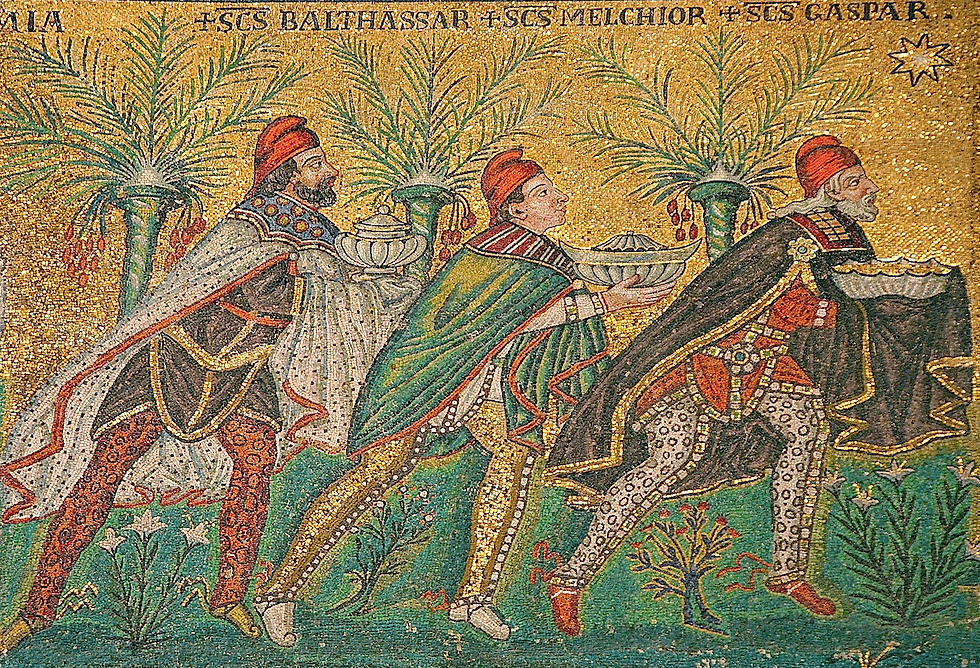
As I stood there looking up at it, I was struck by the fact that all three are in movement — leaning forward, mid-stride, caught in the act of reaching toward something just ahead of them. Not solemn, not static. Almost athletic. Two of them are young — younger than I had ever pictured a "wise man." Not old men chasing a memory, but young men straining after something they had only just glimpsed. Nothing about them is finished, arrived, resolved. They are still going, heading somewhere.
That image remained with me — these mysterious men in their curious dress, crossing the world simply because they saw a star. It almost didn't seem logical, but the absence of logic was where I sensed the magic was. So these Magi, so far away from me in time and place, began to tug at my imagination. As time passed, little snippets of their possible story appeared, like pieces of a lost puzzle. Could I find the other pieces and help make it whole?
The missing record
What if I tried to recapture some of that magic in a story, I wondered. But a historical novel felt daunting from the start. If I wrote a book about the Magi, I would want it to be a work of history — the researched kind, grounded in what the historical record preserves. And the record does exist for nearly all of it: documentation of the Parthian Empire in that generation, of the class of magi who read the sky as part of their office, of the Silk Road at that stretch of its long life, of Judea under Rome, of Herod.
But the record is scattered — pieces in separate sources, separate languages, separate scholarly disciplines. And what is missing from the historical record is documentation of the Magi as individuals — the actual men who made the journey.
Could I gather those pieces of the puzzle, sort and verify them, and fit them together into a picture that could carry the heart of the story? Could these men — not the legend, but who they actually were — come to life on the page? The idea felt monumental, something beyond what I thought I could do. So I put it off. Year after year.
Chunking it
Then one day I began to reflect on what I used to tell my high school students. They would complain that a project was too hard — "I can't do it, Mister!" They were right, sometimes; a nine-part poster on the origins and history of World War II was a tough job for a tenth grader. To accomplish it, we began to chunk it — breaking it into pieces small enough to tackle, one little chunk at a time.
If it worked for them, it should work for me, I thought. I put my procrastinating aside, made an outline of the story that was in my head, broke that outline into small chunks, and began.
Once I gave myself over to the research, something in the story began to flow, almost without effort. Over the months that followed, I could see these men in my imagination — their lives, their quest, what they found, what they lost — and then, as best I could, I began to write it down.
To be honest, I don't fully know where the tale came from. As the characters emerged and their journey played out, it felt less like something I invented and more like something I discovered. I can't explain it any better than that.

Where it was written
Some of the writing happened at our place in Tuscany, in the quiet evenings after dinner, as the sun set and the stars crept out. Some happened in Rome, at the Biblioteca Vallicelliana — a library founded by Filippo Neri in 1565, housed in a hall by Borromini near Piazza Navona. The wooden stacks, the creaking floor, the light through the tall windows — that historical atmosphere transported me into the world I was writing about. And some happened much closer to home, at my local library here in California.
The story traveled back and forth with me, countless times, between California and Italy — the product of being immersed in history on one side of the ocean, and having a still, unhurried place to work close to home on the other.
Befana
Another piece of the puzzle was Italian folklore — and one figure in particular who belongs to any Italian holiday season. I first encountered her years earlier, in a very different setting — my first year in seminary outside Rome, long before I imagined writing this book. One evening at dinner, an old woman suddenly appeared in the cafeteria doorway — hunched, cackling, throwing candy at us from a bucket. I sat there completely bewildered while everyone around me laughed and cheered. It took me a moment to realize this was one of my fellow seminarians, dressed up for the occasion. "What on earth—" I started to say. Later, someone explained who she was supposed to be: Befana.
She is the old woman who flies over Italy on the night of Epiphany, leaving small gifts at the doors of children. The folk story says the Magi stopped at her house on their way to Bethlehem and asked her to join them, and she turned them away because she was busy sweeping. She regretted it. She has been searching for the child ever since.
I think of Befana as the shadow companion to the feeling I opened this post with. She is the one who sensed the mystery passing by and did not run to meet it, and who has been trying to catch up with it ever since. Anyone who has stood at a kitchen window in December and felt something slip away already knows her.

The pieces fit
The longing, the mosaic, the research, the chunking, the hours in the libraries of Rome and here in Palm Springs — even Befana — all became, without my quite planning it, pieces of the same puzzle. Together, they turned into an invitation into another world: the world of the Magi.
It became something I hadn't quite planned — a book about meaning, about searching for purpose and fulfillment, that stirring which animates so much of what we do. It isn't so much about clarity as about willingness. Maybe not a question of knowing, but of following. One of my characters puts it better than I can: "Ours was a road not of certainty, but of trust." That's the line I keep coming back to, long after I finished writing it.
The book
Magi: A Historical Novel is out today. It is told by Mithradat, a young Parthian Magus, traveling west with his father and two companions, following a star none of them can fully explain.
That's the novel. Behind it lies its own journey — shaped by a moment in Ravenna, grown through years in California, deepened in the libraries of Rome, and finally written, page by page, between two homes — California and Italy. The men who made the journey were marked by it. I hope, in reading it, you will be too.

You can find Magi: A Historical Novel here: Get your copy


Comments